
Knox County Release Record Basics
A released person has left a particular custodian. That statement does not always mean the person went home. Knox County Jail may record a bond release, completion of a county sentence, dismissal followed by release, or another court-authorized exit. It may instead record a transfer, commitment, bench warrant, federal pickup, or immigration pickup. Each label has a different effect. A bond release ends jail confinement while the criminal case remains open. Time served means the custodial part of the sentence was met, though other duties or supervision may remain. A transfer ends the Knox County custody episode but continues detention elsewhere.
The most reliable Knox County release proof joins two kinds of records. The jail entry establishes who left, when the physical exit occurred, and whether another agency received the person. The court file explains the legal basis, such as a bond order, dismissal, judgment, sentence, or commitment. Neither record should be stretched beyond its role. A court dismissal does not prove the precise time someone walked out, and an entry showing release on bond does not mean the charge ended.
- Release
- The end of confinement by one custodian, sometimes into supervision.
- Discharge
- Completion of a custody or supervision obligation identified by the agency.
- Transfer
- Movement to another custodian, not freedom in the community.
- Detainer
- A request or legal basis for another agency to take custody.
Knox County Release Types
The release authority matters more than a name disappearing from a list. Knox County does not publish an online jail roster or release archive, so there is no local screen that supplies a definitive label. Ask for the label used in the underlying booking and release record. If staff give only a date, ask whether the event was a community release or a transfer and whether a receiving agency appears.
| Recorded event | What it generally establishes |
|---|---|
| Bond | The person left pretrial jail custody subject to the case and bond terms. |
| Time served | The recorded custodial portion was satisfied; another hold may still matter. |
| Court order or dismissal | A legal basis ended, but the jail entry proves the physical exit. |
| Parole or mandatory supervision | State confinement ended while TDCJ supervision continued. |
| Transfer or commitment | Custody continued with TDCJ, another county, USMS, BOP, or ICE. |
| Death or escape | Custody changed or ended, but the event is not a release. |
Several cases can affect one person at once. A bond posted in one case may not clear a second warrant. Keep each booking number, court case, and agency event separate. Note: A release amount or eligible date never proves that all holds cleared or that the person actually left.
Knox County Release Record Fields
Knox County publishes no online field schema. A narrow written request should seek the existing “booking and release record,” “jail card,” or equivalent record for one custody episode. Identify the person with a full name and date of birth, then add a booking number and approximate date range when known. Asking for a field does not prove it exists or must be disclosed. The sheriff may redact information or apply a statutory exception.
| Requested field | Why it matters |
|---|---|
| Booking date and time | Identifies the correct custody episode. |
| Release date and time | Documents when Knox custody ended. |
| Release reason or authority | Distinguishes bond, sentence completion, order, and transfer. |
| Destination or receiving agency | Shows whether custody continued elsewhere. |
| Charges and bond data | Connects the jail event to the proper court case. |
| Booking number and photograph | Helps resolve identity and associates the image with one episode. |
Older records may not remain in a public-facing system even when the custodian retains them. No official Knox retention period was found, so no fixed number of years should be assumed. Request older jail material from the sheriff and older court outcomes from the combined County and District Clerk.
Request Knox County Release Records
Texas Government Code Chapter 552 supplies the baseline right to inspect or copy public information. The request goes to the governmental body that holds the record. No special form is required, but an agency does not have to answer questions, conduct research, or create a new record. Name an existing document and describe one custody episode with enough detail to locate it.
- Confirm the correct person with full name, date of birth, booking number if known, and a narrow date range.
- Ask the Knox County Sheriff for the booking and release record, release entry, destination, and booking photograph for that episode.
- Request electronic copies when practical and ask for a cost estimate before work that may create charges.
- Ask the County and District Clerk for the docket and signed order or judgment tied to the event.
- If a field is missing, ask whether it does not exist, appears in another named record, or was withheld.
No Knox-specific fee schedule or records-office hours were found. Do not assume the request is free. Texas law permits exceptions, including provisions for some law-enforcement material and confidential information. The Texas Attorney General request guide explains the process, but the originating office must retrieve the record.
Knox County Court Release Proof
Release confirmation follows a split local court map. The combined County and District Clerk is the practical records doorway. The 50th District Court is the felony path. The constitutional County Court also has a criminal caseload, while Justice of the Peace material may document a magistrate stage rather than the final felony judgment. Ask for the document that matches the event, not merely a docket summary.
A signed bond order can explain why pretrial custody should end. A dismissal order or judgment of acquittal resolves the stated charge, yet an unrelated warrant may still hold the person. A judgment and sentence may show jail-time credit or state commitment. Pair that legal record with the jail’s actual release or transfer entry. If dates conflict, preserve each agency’s label and ask the custodian to resolve the mismatch.
The clerk screenshot below shows the official local route for court records. The Knox County County and District Clerk page identifies the office that holds the relevant case file.
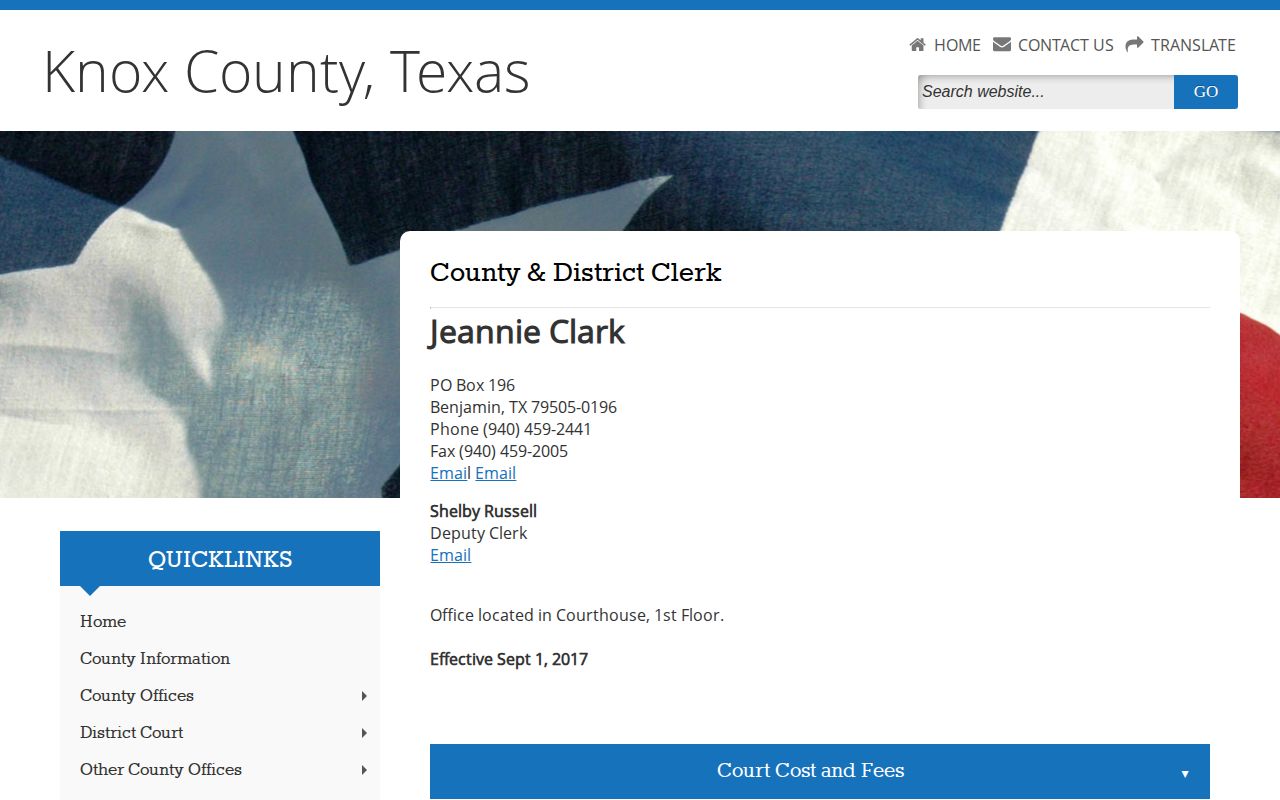
The court file explains the legal result, while the sheriff record remains the better source for the exact jail exit.
Find Knox County Released Inmates
Start with the last known custodian. For a local arrest, call Knox County Jail at 940-459-2041. Give the full name, date of birth, and approximate booking date. Ask whether the record shows the person currently held, released to the community, or transferred. A limited phone answer can direct the search, but the written record is stronger proof. Then use the court case to verify the order or judgment behind the event.
- Identify the local, state, federal, immigration, or other county system involved.
- Obtain a positive, dated release or transfer entry from that custodian.
- Check the court order, judgment, or agency decision that explains the event.
- If the entry names another custodian, search that system before describing the person as free.
- Use stable identifiers and record all date labels exactly as the agency gives them.
For one named person, this full path is more reliable than a supposed recent-release list. The Knox County 24-Hour Release List explains the same-day phone and record fallback when no feed exists.
TDCJ Knox County Release Search
A transfer from Knox County Jail to the Texas Department of Criminal Justice is not a community release. While the person is confined in state prison, use the TDCJ offender search. TDCJ states that this public search covers current inmates, updates on working days, and can be at least 24 hours old. A person who has actually discharged may disappear, so a later no-result does not establish why state custody ended.
| Search input or result | Use |
|---|---|
| Last and first name | Starts a name search; exact spelling improves the match. |
| TDCJ or SID number | Separates people with similar names. |
| Gender and race | Narrows results but does not replace identity checks. |
| Location and offenses | Shows current state custody and case context. |
| Projected or scheduled date | A forecast or planned event, not proof of actual release. |
The TDCJ email channel, inmate information lines at 936-295-6371 or 800-535-0283, and the TDCJ Public Information Act route supply historical fallbacks. Ask for the actual release or discharge record rather than inferring discharge from the current-only search.
The official form shown below is available from the TDCJ current-inmate search.
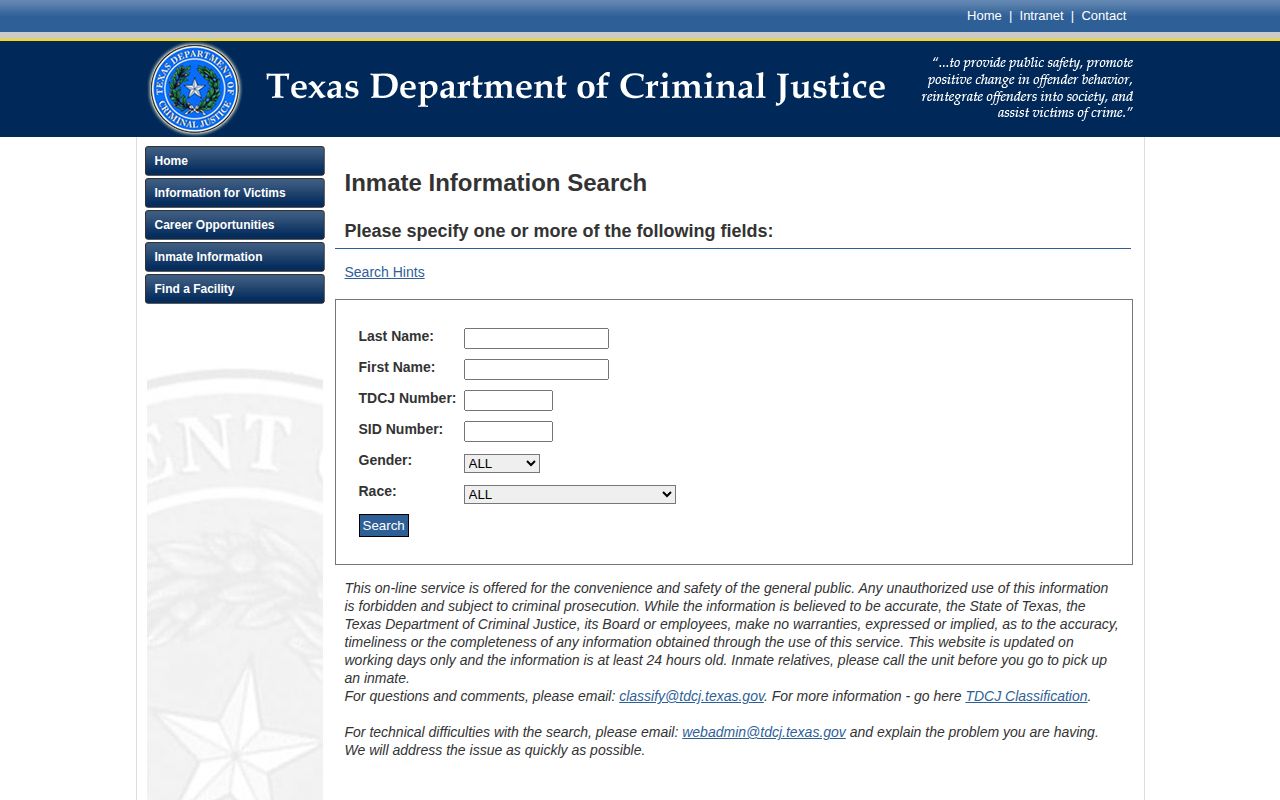
Its fields help locate a current state prisoner, while historical release confirmation requires TDCJ staff or records.
Knox County Custody Comparisons
The next search depends on which agency controlled the person after Knox custody. Systems do not share one universal meaning for a missing result. Match each tool to the status it is built to prove.
| Reported status | Best source | What confirms it |
|---|---|---|
| Still in Knox jail | Jail phone | Current status from the local custodian. |
| Released from Knox jail | Sheriff record plus court file | Dated release entry and legal basis. |
| Transferred to TDCJ | TDCJ current search | Positive current-inmate result after data updates. |
| Discharged from TDCJ | TDCJ information or PIA | Actual state release or discharge record. |
| Federal release | BOP locator or federal record | Past release date or official federal document. |
| ICE custody change | ICE ODLS and sheriff entry | Current or recent ICE result tied to the county transfer. |
Texas IVSS-Counties can provide custody and supervision alerts where a record participates, but it states that it is not an official record and that people no longer in custody may not appear. Use an alert as a prompt to obtain the agency record.
Texas Release Alerts for Knox
Texas replaced county VINE/VINELink with IVSS-Counties on September 1, 2025. Knox participation should be checked rather than assumed. The portal accepts full or partial names and identifiers such as DOC, state, jail, or permanent booking numbers. It may show a custody or supervision match and permit notices for custody changes. Migrated users must review portal credentials and preferences.
Search without registering first, select the matching person with care, and then create an account through the IVSS registration page if notifications are available. Preserve the notice date and event wording. Next, request the sheriff or TDCJ record. IVSS is not a historical Knox release archive, and a no-result can reflect participation, scope, identity, delay, or removal after custody ends.
Special-purpose registries answer narrower questions. The Texas DPS registry concerns only people with an active public registration duty. It does not prove a jail release date or type.
Federal Knox County Release Checks
Federal custody needs a separate path. A person held for federal court may remain under the United States Marshals Service before any BOP placement. USMS has no public released-person name search comparable to BOP, so the federal docket or a federal records request may be necessary. Once a sentenced person enters BOP, the BOP inmate locator can cover federal prisoners released since 1982.
A BOP result with a past release date and no current BOP location confirms the end of that BOP custody episode. It does not rule out supervised release, a new case, or transfer to another authority. Likewise, an early BOP no-result can mean the person is still held by USMS or never entered BOP. Search with a Register, FBI, DCDC, or INS number when available, or use a name with age, race, and sex filters.
The national BOP locator shown here is the proper federal search, not a Knox County jail tool.
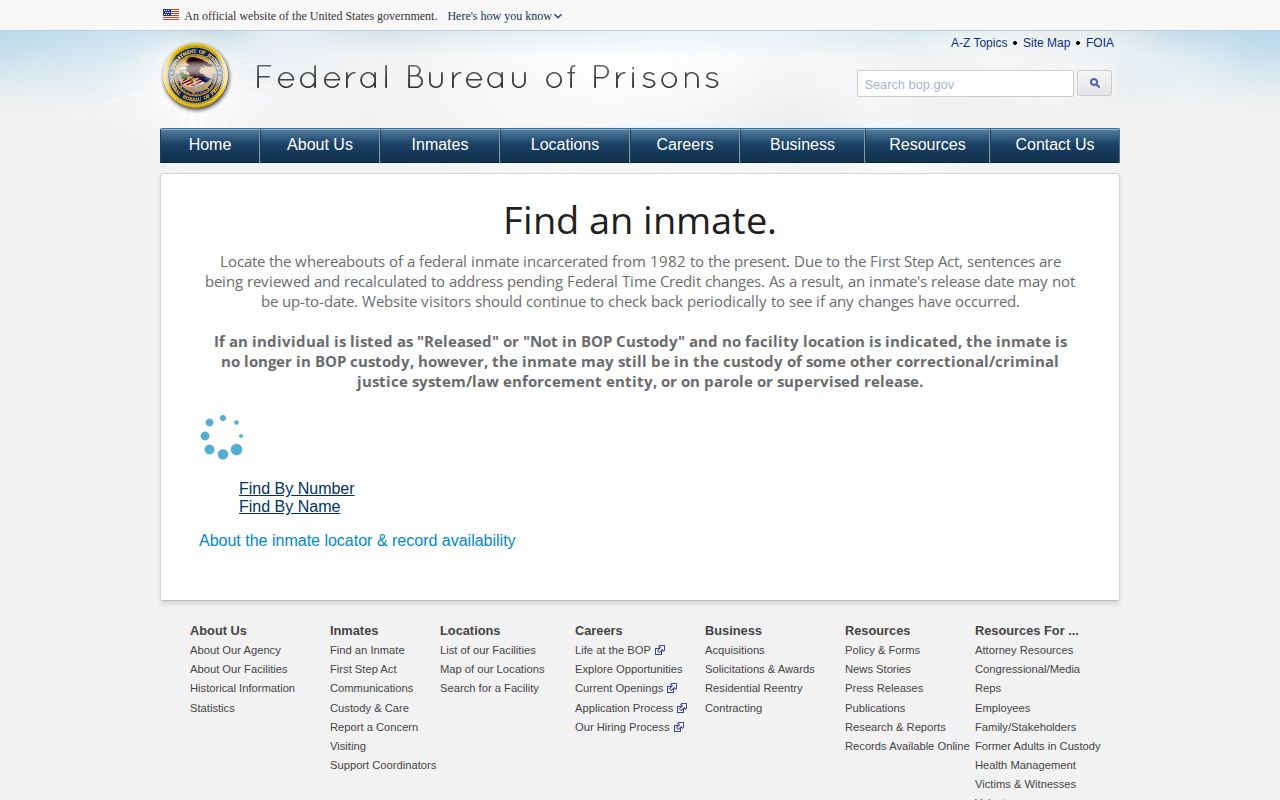
A past date should be described as the end of BOP custody, with any later custodian or supervision checked separately.
ICE Knox County Release Checks
An immigration detainer can turn a county exit into an ICE transfer. Ask the sheriff whether the disposition names ICE or another immigration custodian. Then use the ICE Online Detainee Locator with an A-number and country of birth or exact biographical information. ICE guidance describes current custody and recent releases within the preceding 60 days, but ODLS is not a general county-jail search.
A current ICE result after the Knox exit proves detention continued. A recent-release result concerns the immigration custody episode, not the earlier county event. Keep both dates. If the person does not appear, verify identifiers and use ICE contacts plus the original sheriff record. A missing ODLS result can reflect scope, timing, or identity mismatch and cannot support a claim of freedom.
Note: County release, state discharge, federal release, and immigration release are distinct events that should retain their agency labels.
Knox County Jail Local Scale
A dated Texas Commission on Jail Standards report listed Knox County Jail with 14 beds and an average daily population of five for the May 2020 through April 2021 calculation. Those figures are historical context. They are not current occupancy, annual bookings, or annual releases. No supported current population or release total should be inferred from them.
The small reported scale makes transfer versus release especially important. Knox has one established local jail and no TDCJ prison unit in the county. A defendant committed to state prison can disappear from local custody while remaining confined elsewhere. The state search may not show the transfer immediately because of intake and update lag. Check the sheriff’s receiving-agency field first, then check TDCJ with the same identity details.
Knox County Facility Geography
Knox County’s official page places the jail at 104 S. Stewart Street in Benjamin, west of the courthouse. The sheriff office is separately listed at 111 E. Hayes Street. That distinction matters when directing a request or confirming which office holds a record. No state prison, federal prison, or ICE detention facility was established inside Knox County through the official directories reviewed.
A local arrest ordinarily starts at Knox County Jail, but the record may point outward. TDCJ serves state commitments through its statewide system. BOP and USMS handle different parts of a federal custody path. ICE handles federal civil immigration custody. Another county may execute its own warrant. The four facility pages preserve these boundaries:
- Knox County Jail
- Texas Department of Criminal Justice statewide system
- Federal Bureau of Prisons system
- ICE detention system
Each destination needs its own dated record. Do not merge a Knox transfer date with a later release date from the receiving agency.
Avoid Knox County Search Mix-Ups
The county name creates a serious research trap. Knox County, Tennessee publishes a highly ranked “24 Hours In Custody” product. It belongs to a different sheriff and a different state. Tennessee results often show Knoxville and an 865 area code. The controlling Texas identity is Benjamin and the 940 area code. Never copy a Tennessee roster, release window, photograph, policy, or contact into a Texas record.
Check the state name, city, agency seal, area code, and source domain before relying on a result. Generic directories can repeat unsupported claims about rosters, mugshots, release schedules, property, or apps. Knox County, Texas has no official online roster, recent-release window, sheriff app, or booking-photo gallery in the completed source sweep. The absence is a reason to use direct records, not to substitute a polished page from another county.
Public Record Search
Sponsored Results