
Knox Released Mugshots as Records
A booking photograph records how a person appeared during one arrest and booking episode. It is not a portrait of current status. The image does not prove guilt, conviction, release, or continued detention. Even a genuine Knox County Jail photo must be matched to the booking date, charges, release entry, and later court disposition before it can support an accurate account.
Texas public-information law does not make every booking photograph categorically secret or categorically available in every case. Government Code Section 552.021 supplies the baseline right to inspect or copy public information held by a governmental body. Exceptions can protect active law-enforcement material, confidential personal information, juvenile records, and records affected by a court order. The Knox County Sheriff decides the response for the record it holds. A requester should ask for an existing photograph, not demand that staff create a new report.
Release does not erase the underlying booking episode. It also does not tell a reader whether the charge was dismissed, resulted in acquittal, led to conviction, or remains pending. The combined Knox County and District Clerk holds the court path for those legal outcomes. The sheriff's release entry supplies the physical custody event. Keeping those two records with the photograph prevents a dated image from being mistaken for a present fact.
Where Knox Released Mugshots Appear
Knox County has no official online mugshot gallery. The useful channels differ by custodian, and several common sources do not apply to an ordinary county bond release.
| Channel | Has Photo? | How to Access |
|---|---|---|
| Knox sheriff web feed | No feed established | Use the official contact and written-record route |
| Knox sheriff mobile app | No official app established | Do not rely on third-party app claims |
| Sheriff booking record | An existing photo may be responsive | Request the named booking episode in writing |
| TDCJ identification photo | Relevant only after TDCJ admission | Use a formal TDCJ PIA request |
| DPS registry | Only for a public registrant | Use the official registry and do not treat it as a release archive |
| Texas IVSS-Counties | Not a permanent photo archive | Use for participating custody alerts, then verify |
| Private publisher or news report | Sometimes | Treat the image as a lead and check government records |
A county bond release will not create a TDCJ photograph. Likewise, a DPS registry image exists only where a public registration duty applies. Neither system should be searched as though it held all Knox County released inmate mugshots. Start with the agency named on the custody record.
No Knox Mugshot Feed or App
The official Knox County Sheriff page is a contact and location page. It publishes no inmate roster, released-person gallery, booking-photo stream, archive, retention window, or official mobile app. There is no supported claim that an image remains online for a set number of hours after release. The honest local route is a phone call for navigation followed by a narrow written request.
This absence also creates a serious county-name trap. Search results for Knox County, Tennessee may show a polished custody product and photos, but those records concern Knoxville and typically use an 865 area code. Knox County, Texas sources point to Benjamin and use 940 contacts. Never import a Tennessee photo, release window, or app into a Texas record.
The absence of an official app is itself angle F from the local research. Third-party claims about a sheriff photo feature are nonofficial until the Texas sheriff links or confirms them. The same caution applies to a supposed Knox County 24-hour release list: the Texas sheriff publishes no such feed.
The official sheriff page is the source for this local finding. Its captured view shows the contact-only design:
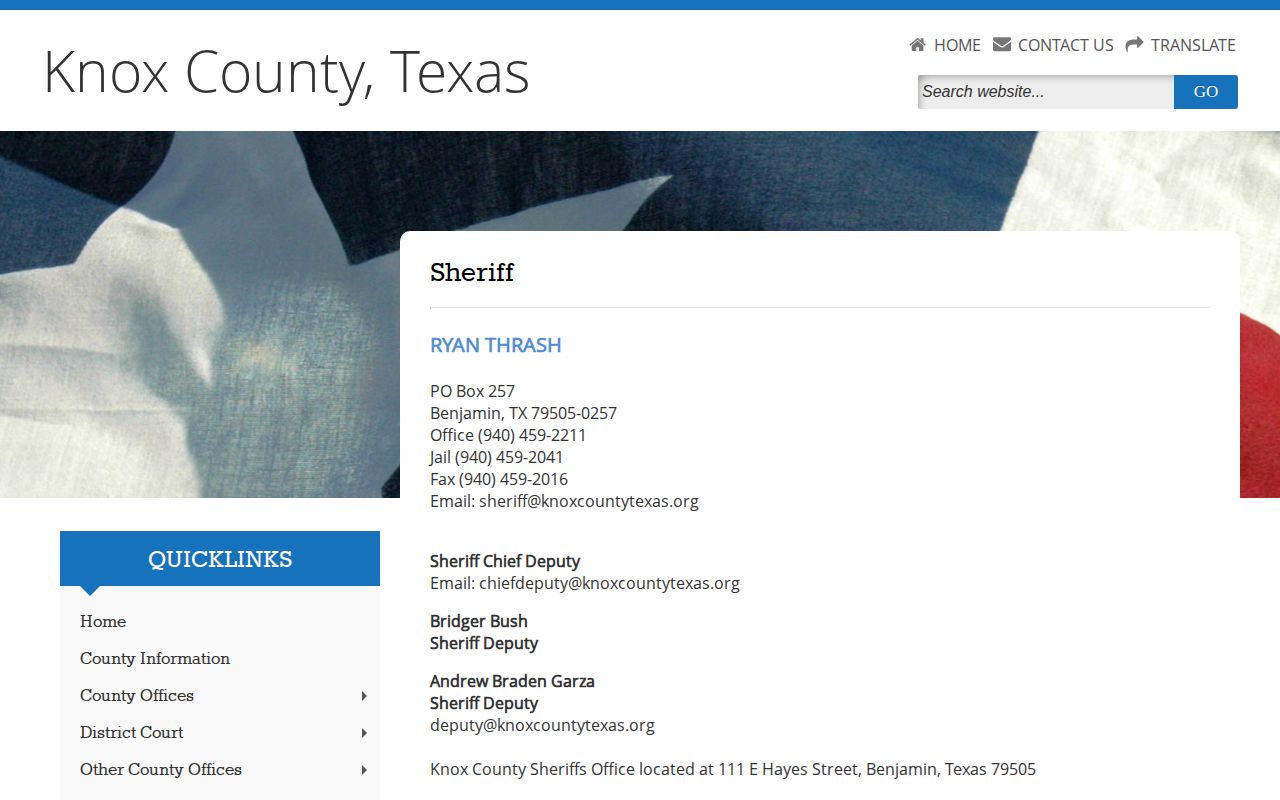
The screenshot supports the records-request fallback because no roster, mugshot gallery, or release-photo tab appears on the official page.
Request Knox County Booking Photos
A focused request gives the custodian a concrete record to find. Knox County posts no special PIA form, dedicated records email, local fee schedule, or records-unit hours. Send the request to the sheriff by mail at PO Box 257, Benjamin, TX 79505-0257, or by fax at 940-459-2016. Hand delivery may go to 111 E. Hayes Street after confirming the route at 940-459-2211. The jail line is 940-459-2041.
- Give the person's full name and date of birth.
- Add the booking number and approximate custody dates if known.
- Ask for the existing booking photograph associated with that episode.
- Request the booking and release timestamps, release reason or authority, destination or receiving agency, charges, and bond fields in the same request.
- Prefer an electronic copy and ask for an estimate before charges beyond a chosen amount.
- Keep the response, correspondence, and any withholding explanation with the related court record.
The agency does not have to create a conclusion or answer legal questions. If a field is missing, ask whether it does not exist, appears in another named record, or was withheld. Under Section 552.2615, an estimate over $40 triggers a written itemized-estimate process. Section 552.221 requires prompt production, but ten business days is not a universal production deadline. When records cannot be produced within that period, the agency provides written certification and a reasonable date.
Use the combined County and District Clerk for the disposition, judgment, sentence, dismissal, or bond order. That office is on the courthouse first floor and receives mail at PO Box 196, Benjamin, TX 79505-0196. Its phone is 940-459-2441 and fax is 940-459-2005. The Knox County release-record guide explains why the image and custody record should be paired.
Verify Knox Mugshots Found Elsewhere
A private publisher may retain an old arrest photo after the person leaves custody. Local or regional news may also preserve an image used in an arrest report. These channels can point to a date or agency, but they cannot establish the present custody state. A news image proves only that the image appeared in that report's historical context.
Check the full name, date of birth where lawfully available, booking date, agency, case number, and photo source. Then compare the image with the sheriff record and the signed court disposition. Avoid links to commercial mugshot publishers, data brokers, and paid removal services. The official record should control any correction, not a search-result caption or a reused image with no source date.
For a person who entered state prison, the routine TDCJ inmate-information email service expressly excludes photographs. A formal TDCJ Public Information Act request is the proper route for an existing departmental identification photo. A TDCJ image documents state admission, not the earlier Knox booking and not a later release.
The successful capture of that official request page shows the formal channel:
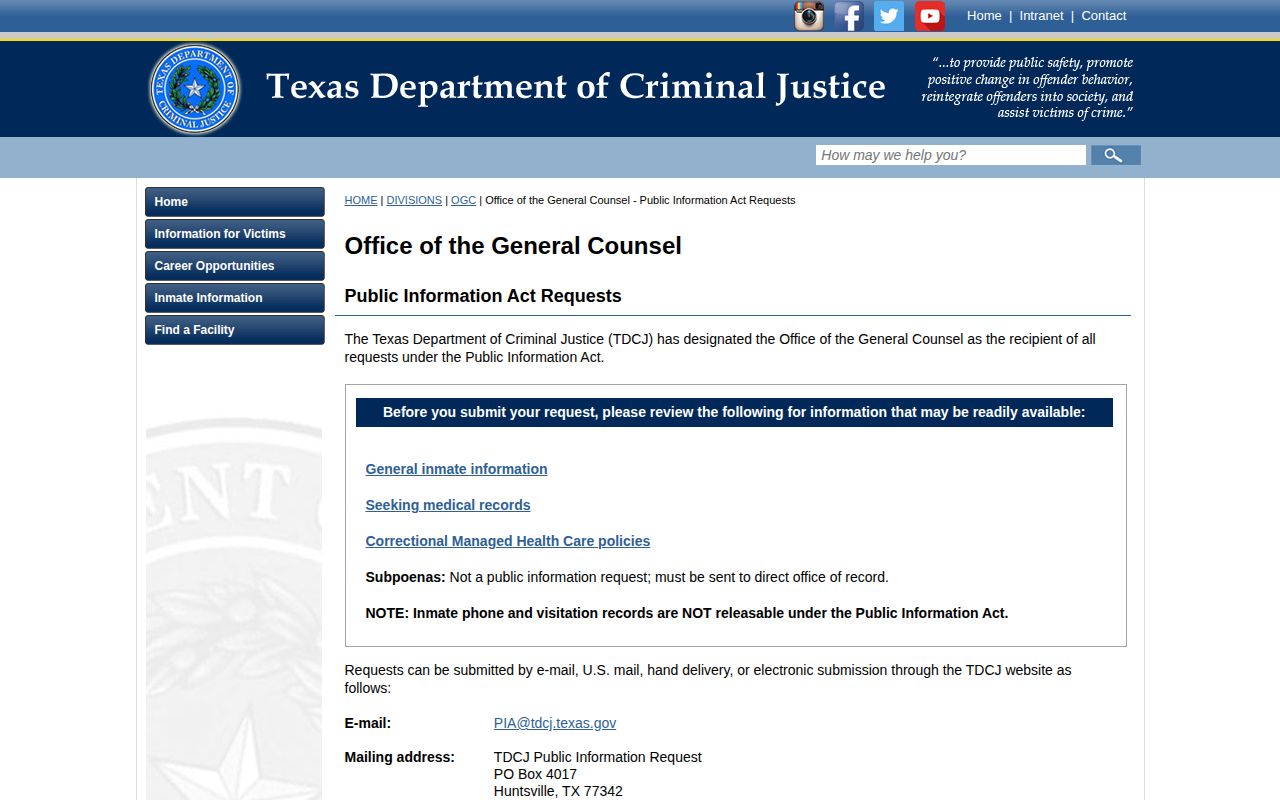
Use this state route only for TDCJ records. The Knox sheriff remains the custodian for the county booking image.
Knox Mugshot Expunction and Nondisclosure
Release, bond, or dismissal does not automatically erase an arrest image. Texas expunction law is in Code of Criminal Procedure Chapter 55A. It includes qualifying categories and detailed conditions based on the disposition, offense, dates, later history, and statutory route. An expunction order can require covered agencies to destroy or return records. Nondisclosure under Government Code Chapter 411 is different. It limits public dissemination in qualifying cases while authorized entities may retain access.
Do not promise removal before a valid order exists. Once an order is signed, send it to each agency or covered publisher within its scope and retain proof of notice. If the government source displays inaccurate data without an expunction issue, identify the exact error, booking episode, and supporting disposition in a correction request.
Texas Chapter 109 Mugshot Disputes
Texas Business and Commerce Code Chapter 109 is a limited accuracy, dispute, and anti-pay-to-remove law. It does not create universal deletion of every truthful sheriff or news image. Coverage depends on the publisher and business model. General-circulation news organizations and other listed services may fall outside the covered class.
A covered criminal-record publisher must provide a conspicuous dispute contact and investigate a completeness or accuracy dispute free of charge. The investigation must finish by the 45th business day. When the information is incomplete or inaccurate, the covered entity must correct or remove it as required and cannot charge a correction fee. Written results are due within five business days after completion.
Section 109.005 addresses information made confidential or covered by an expunction or nondisclosure order. Government Code Section 552.1425 separately restricts compensated private compilers after notice of such an order. The useful course is to document the error or order, notify the entity that holds the image, and keep the response. Paying an unverified removal service does not replace these legal steps.